
Writerly Things, Entry 23
Mosaic Is Taking Shape

Ten Second Takeaway
Updates on MOSAIC — Audiobook Update — Ries Reviews
It’s Summertime!
Happy July, everyone! We’ve had our share of tornadoes and bad weather here in Indiana, so I hope everyone reading this is staying safe and getting sun. (Though not too much sun … I woke up to an “extreme heat” warning on my phone the other day, which has to be a first.)
Lots to talk about in the coming months, so I’ll do my best to keep these updates brief and to the point in terms of length and content. No point in dallying; let’s dive in.
Progress Update: MOSAIC
I am currently deep into the Assembly phase of Mosaic, with the personal goal of having draft 1.0 completed by the end of July. For those unaware, “Assembly” in this case follows “Drafting,” which concluded at the end of April.
When it comes to writing, I tend to follow the Hemingway guidance, at least for drafting: I “sit down at the typewriter and bleed”. The consequence of that approach is that you have to know when to stop (when to put a tourniquet on it, to continue the metaphor), and then comes the task of actually turning the drawer of parts into something coherent. That process—of conjuring the story—is called Assembly.
What Is Assembly?
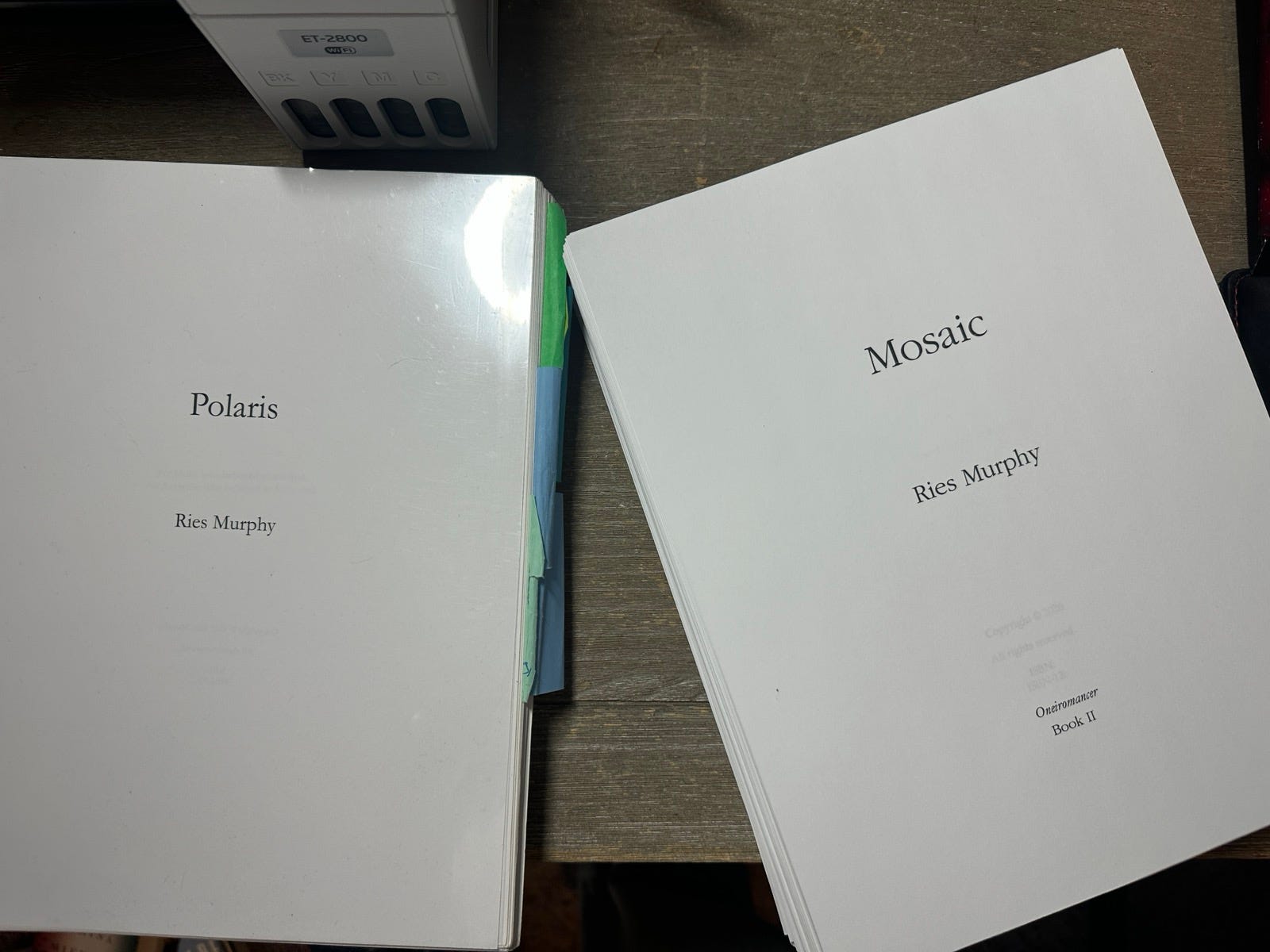
The first thing I do with Assembly is print the entire manuscript. That’s always fun, because it’s the first time the work has a physical presence in the world. There’s something superficially yet tremendously satisfying about dropping your manuscript on a table and watching the whole thing quake.
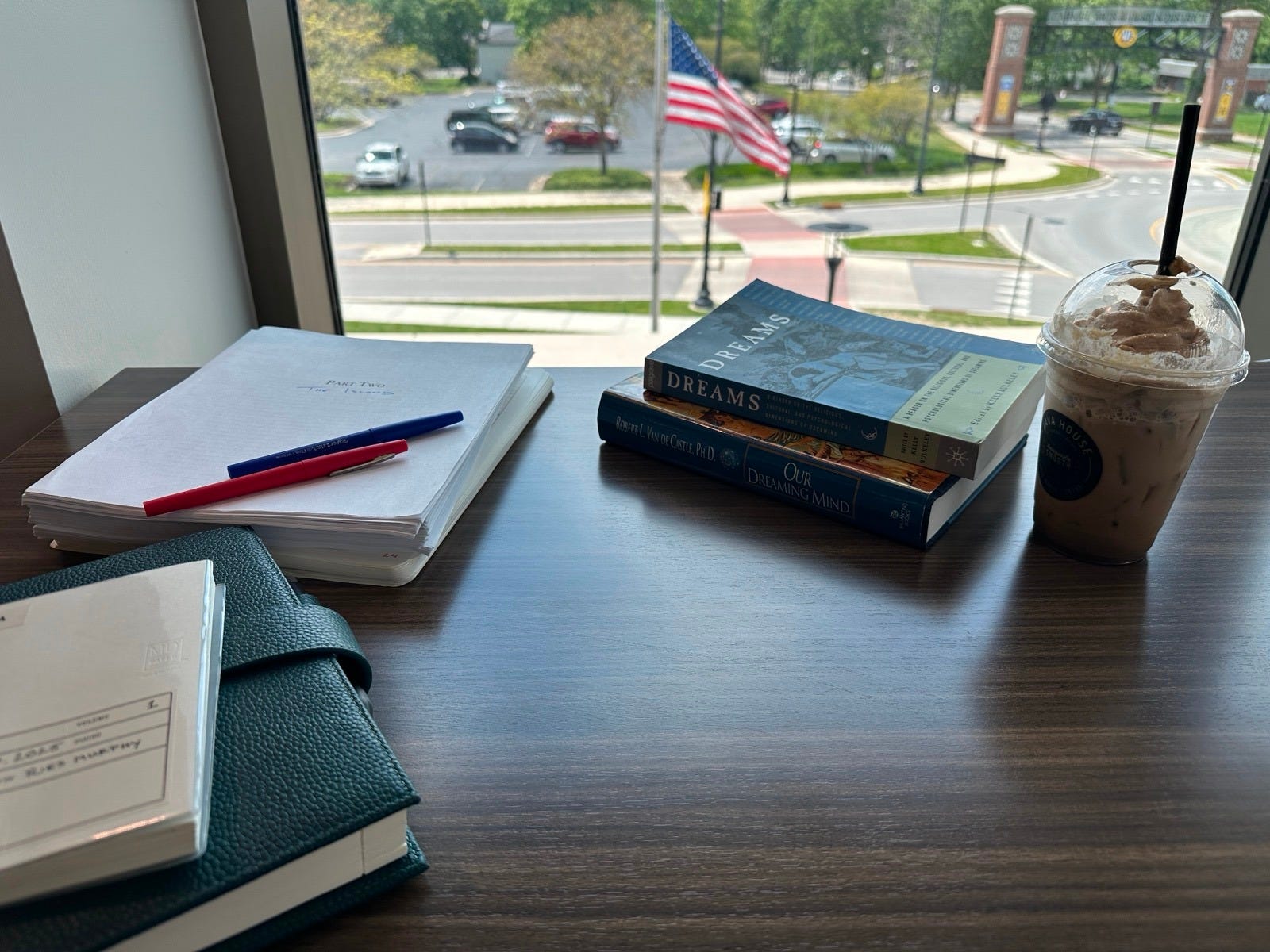
Next, I read through what’s there, cover to cover, with blue and red pens in tow. I keep a “workbook” for this process where I capture a running commentary on what I’m seeing, how to stitch together different characters and plots, and whether pages or chapters are salvageable or not.
That step (a sub-step I call “Inventory”) usually takes about a month. This is where the book starts to have a pulse. I wrapped up that first step—Inventory—for Mosaic on May 30th.
Following “Inventory,” the next sub-step of “Assembly” is called “Construction”. This is where I am right now, and Construction is exactly what it sounds like: lots of heavy machinery and cranes; lots of splinters in the metaphorical hand; lots of sunflower seeds and coffee in styrofoam cups.
Construction is where I work from the front of the manuscript to the back of the book, using the notes I wrote for myself during Inventory. This is the most labor-intensive of all the steps, with the creative demand of Drafting but the craftsman’s rigor of early editing.
If I had to put my finger on the most demoralizing bit of the entire process of writing a book, this would be it. In Construction, simply getting words on the page is no longer enough; you have to make something.
The good news?
On the far side of this step is the coveted Draft 1.0; the first shareable version of the book, the part where the book gets up off the table and starts to stumble around.
It’s easy to get impatient. I’m doing my best not to be.
I hope to have Draft 1.0 finished by the end of July, and out to my Alpha Readers sometime in August, or September at the latest.
Audiobook Update: POLARIS
Okay. Onto some exciting news.
Friends, it’s official—we’re going to try and get Polaris made into an audiobook.
I’ll have more information here on the Anecdotal* in the coming weeks and months, but my goal is to launch a Kickstarter campaign for a Polaris audiobook sometime in the early fall. To be honest, this is probably the second most exciting thing I’ve built towards outside publishing Polaris itself in February.
Keep an eye here/in your email for more information on that endeavor. Get ready to rabble-rouse your friends and coworkers: this will be a fun one.
This Month’s Observation: On Notebooks
When I was a kid, I was obsessed with The Lord of the Rings.
This was true about both the book(s) and the films. In the movie, specifically, various characters interacted with absolutely massive tomes. One scene in particular resonated with me: when Gandalf picks up the massive book in Moria. That was the moment I became obsessed with big journals, and big notebooks.
For years, I bought the thickest, biggest notebooks I could find. This culminated in a custom, unique book from Epica. It honestly felt a bit like if I could find the right giant book, I’d fill it with great ideas. Rather than “Build it and they will come,” it was more like, “have a big enough book and you’ll have big enough ideas to fill it”.
Imagine my disappointment when it turned out that I couldn’t fill notebooks to save my life. There were exceptions to this, of course: a black Moleskine from when I backpacked through Europe, a green Field Journal from boot camp, or perhaps most remarkably, the time I filled a giant red journal with so much ink that it set off the X-Ray machine when I was flying home from Portugal.
Still—for the most part, I bought journals and never used them. Each time, the story was the same: I’d fill some pages and that would be that. I never referenced them again, or was too precious to doodle on the pages, or hated what I wrote and felt it was a waste. The list of grievances was long and absurd. But it felt for a long time like paper journals and I were star-crossed lovers, doomed never to meet.
In an act of desperation, I tried something completely new for myself, and bought an utterly unstylish, tiny notebook. My goal? Turn it into an everything net (or a butterfly net, as I called it). Take notes in the notebook instead of on my phone. Let them marinate in there for a while. Maybe lift some at a later date. See what happens.
Imagine my surprise when that tiny notebook—the Midori A6 graph—became my most vital and trusted companion in the writing space. I have never in my life relied so thoroughly (and used so ritualistically) any notebook for the explicit purpose of capturing writing ideas. I am about 70% of the way through my first little book; just yesterday, I ordered three more. I fully expect I will fill all of them.
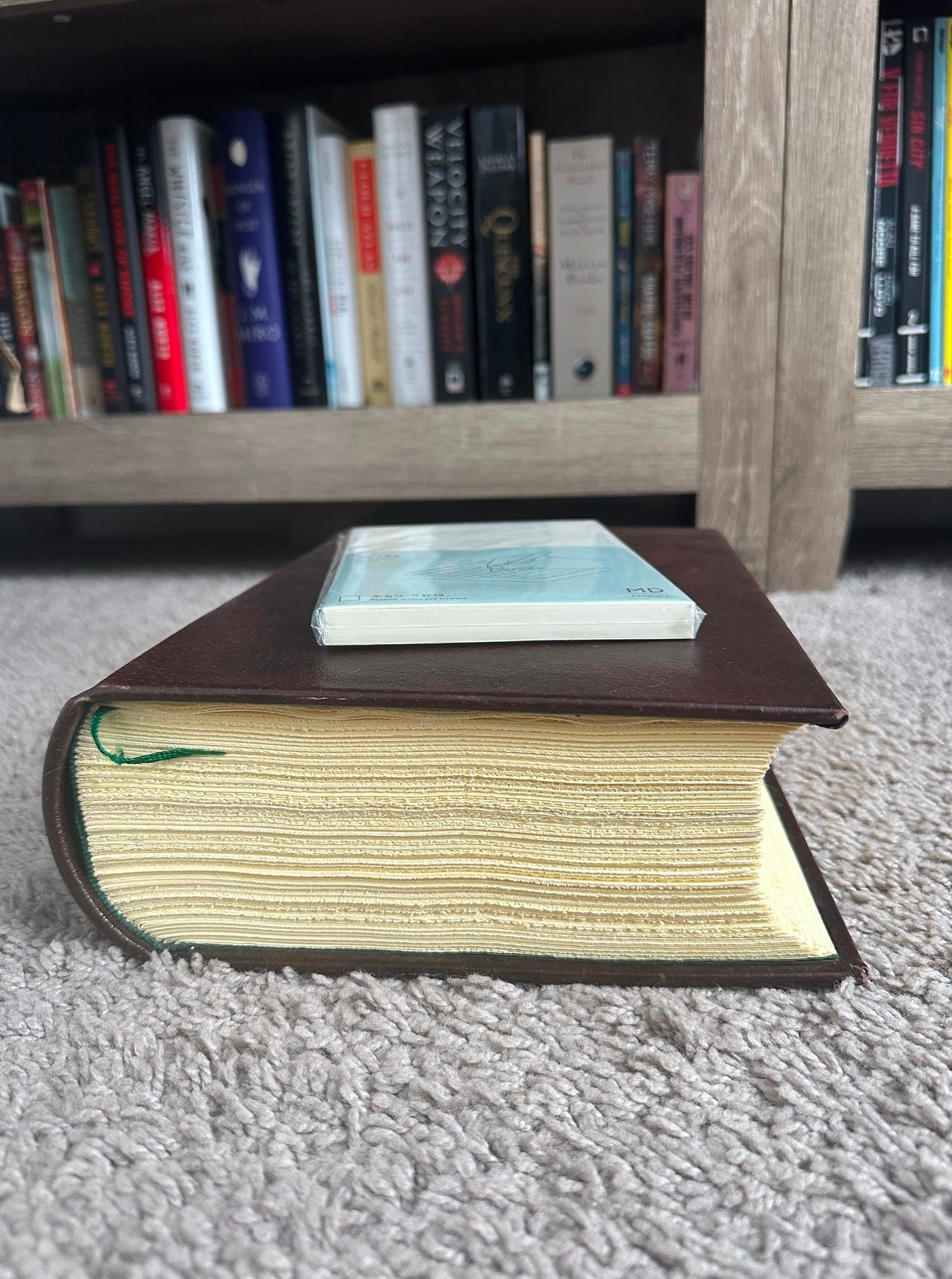
It’s not the giant book from The Lord of the Rings, but it does feel a bit more like a pocket-sized variation of Henry Jones Sr.’s “grail diary” from The Last Crusade. So far as inspiration goes, this is a worthy runner-up. Besides … it works. And as Cogsworth said in Beauty and the Beast: “If it ain’t baroque, don’t fix it!”
The lesson: try new things once in a while.
You might be surprised what works.
Ries Reviews:
“From,” Seasons 4: This is a good puzzle-box show with interesting mythology and an actual ending in sight; Season 5 will be the final season. Season 4 definitely felt like the deep breath before the plunge. So far as finales go, the Season 4 finale was the weakest yet—but it doesn’t diminish my affection for the show. Is it cinema? Absolutely not. Is it a lot of fun? 100%. Recommended for those who like puzzle box stories with gruesome monsters. Score: 7/10
“Obsession,” Curry Barker: Obsession is one of those interesting artifacts where the texture of the film is both vital and detrimental to the overall package. It’s not quite reality, but this is a surreal one-step-off reality that sometimes works and other times cuts off its own momentum at the knees. Wrestling with themes of consent, selfishness, and love, this is a good watch, albeit more sad than scary. Come for the career-defining performance from Inde Navarette and tight direction from Curry Barker. Gruesome, timely, and (at times) darkly funny. Score: 8/10
“Mad Men,” Season 1: I’ve tried watching Mad Men several times over the years, never connecting with it and often quitting after the first few episodes. For whatever reason, my most recent attempt was successful, and I burned through the entirety of Mad Men’s first season in a couple of weeks. There’s not much I can say that hasn’t been said, but this is a real gem of a show. The performances are all rock solid, the visual symbolism is rich and layered, the characters are written like finely tuned machines. Prescient, riveting, and heartbreaking. Score: 9/10
“The Bear,” Season 5: I’d need an entire article to explain what The Bear means to me as a show, so I’ll definitely do that … someday. After a 4 year run, The Bear found a way to close up shop with a lean, intense, emotionally charged final season that feels less like a final season and more like a final couple of turbocharged episodes. With everything on the line and the stakes impossibly high, watching the Bears rally together for one last ferocious struggle was as breathless as it was inspiring. Season 5 was a spectacular ending to a truly spectacular show. Saying goodbye to The Bear was not saying goodbye to television: it was saying goodbye to family. Thanks, Chef. Score: 9/10
Alright folks. That’s it for this update.
Stay cool out there.
—Ries
Same with Mad Men. Maybe I’ll give it another go. Grandson Joe will be glad for the update on Mosaic. He is anxiously waiting. This is going to be like Harry Potter. We all waited anxiously and finally, FINALLY, the next book was released. We devoured it. And then just sat. Read it again for what we missed. And sat. Back to waiting. Sigh.